wrapping it all up (Part 8/12) 🕊️
Paul Tagliamonte 2026-09-08 diyIf you're looking for it, the intro to the PHY (layer 1) that this belongs at a high level and listing of the parts that make it up (including this one) is on the phy post.
The time has come.
If you’re following along at home, we now have all the basics we need to glue these parts together and see what this looks like.
We’re going to build the highest-level constructs for the PHY in code –
something that takes some number of bytes in and writes out IQ samples fit for
transmit over the airwaves (we’ll call this the Encoder), and something that
takes chunks of IQ samples in, writing out decoded bytes (which we’ll call the
Decoder).
Encoder
Let’s begin with the Encoder, since it’s slightly less involved. I’ve tried
to make this a bit more accessible by drawing a diagram out before describing
the order of operations, so that it’s possible to follow along visually.
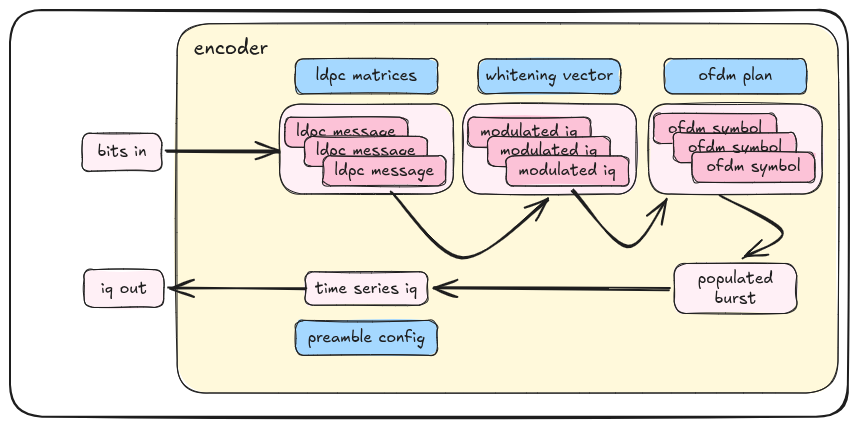
While the process here can look like a lot, it’s really not that bad. We begin by taking the incoming bytes, converting the bytes into bits, and chunk those bits into parts which are sized to fit completely within an LDPC message. We will then encode incoming data into LDPC messages, using our configured LDPC Matrix (the table we appropriated from 802.3an). Next, we apply whitning over all the bits in our encoded (and packed) LDPC messages, using our configured whitening constant. In the case of QPSK, pairs of bits will then be modulated into a QAM subcarrier, where each QAM point represents a range of bits in the message. We’ll go through each of those modulated IQ subcarriers, and set each corresponding data subcarrier in order, for each OFDM symbol contained in the pigeon Burst. The preamble configuration is then used to generate (or, more likely, can be used at startup to precompute) the Schmidl-Cox preamble, which is written to the first IQ samples in our output IQ buffer. Finally, we will do a series of inverse FFT operations to convert each OFDM symbol to the time domain, including their cyclic prefix.
Let’s take a look at doing that, but in code this time now:
// (lightly edited for clarity)
impl Encoder {
  ..

  /// Encode the provided bits into the output time-domain IQ samples.
  fn encode(
    &mut self,
    dst: &mut [IQ],
    src: &Vector,
  ) -> Result<Burst, Error> {
    let src = {
      let mut raw = Vector::new(self.fec.message_len());

      // Set `raw`'s data bits, compute and set LDPC
      // checkbits.
      self.fec.add(&mut raw, src);

      // Apply whitening, and return
      raw.xor(&self.whitening)
    };

    // copy in the precomputed schmidl-cox preamble to `dst`
    let preamble_len = self.preamble_iq.len();
    dst[..preamble_len].copy_from_slice(&self.preamble_iq);

    // allocate a new (frequency domain) 'Burst' container.
    let mut burst = Burst::new(
      &self.mode.ofdm.plan,
      self.mode.ofdm.symbols
    );

    // modulate bits from 'src' as iq, and set each
    // data subcarrier for each ofdm symbol in the
    // burst.
    self.burst_encoder.multiplex(&mut burst, &src);

    // convert from frequency-domain data into time
    // domain iq samples, writing out ofdm symbols
    // and cyclic prefixes to `dst`.
    self.burst_encoder
      .transform(&mut dst[preamble_len..], &burst)?;

    // normalize all IQ samples; the maximum magnitude
    // in the IQ buffer may be very small, which weakens
    // our transmitted signal. Scale all IQ samples such
    // that the maximum IQ sample magnitude will be '1.0'.
    dst.norm();

    Ok(burst)
  }
}
Using the Encoder should hopefully be fairly straightforward – we’ll
give it a bag of bytes, and get back some IQ samples that we can ask our
nearest SDR to transmit.
As for what happens on the other end?
Decoder
Next up is the mirror image of our Encoder – the, imaginatively named,
Decoder. The Decoder is slightly more involved (since it has to find the
packet in the IQ stream, as well as correct for channel error(s)), so we’ll do
the same thing as above – start with a diagram. My hope is going over the
Encoder first helps us only really focus on the “new” stuff, otherwise it
should feel like running the Encoder backwards.
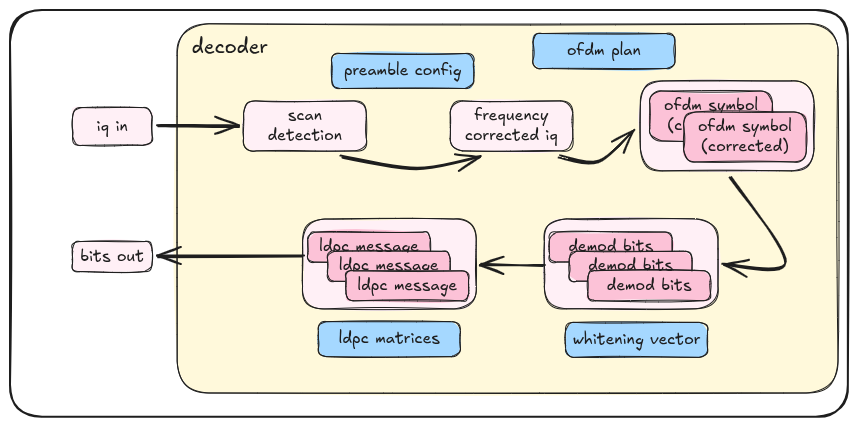
Here, we start with an incoming stream of IQ, where we will process
scan detections as they come in
from our Schmidl-Cox detector and burst Scanner. This will give us a “snippit”
of IQ, sized to exactly our Burst. We’ll begin to correct our IQ samples by
first doing
frequency estimation and correction
in the time domain using our preamble and ofdm configuration. We’ll then do
a series of inverse FFTs to extract each OFDM symbol
in our Burst, where we can then do
channel estimation and correction.
With the OFDM symbols (hopefully) good enough, we can now
map each data subcarrier back to bits, and
unapply whitning. The resulting
bits are then chunked back up into LDPC messages,
which are then checked, and concatanated data extracted. Finally the bits
are turned back into bytes, which are written to our output buffer.
However, before we get into the code to do this – there’s one last detail. We know bursts won’t overlap (if they do, it’s likely not possible to recover right now – even though other PHYs can and do), so any time we see something we believe to be a burst, we can skip ahead by the burst’s (constant) length within the IQ, and avoid trying to decode anything else in there.
The nice side-effect here is this also gives us an interesting property for the
Decoder – namely, we know the maximum number of Burst detections we can
get for a given block of incoming IQ data if they were packed end-to-end – and
we can pre-allocate the memory we need, avoiding allocations for every
demodulation attempt (which may or may not even be a valid Burst).
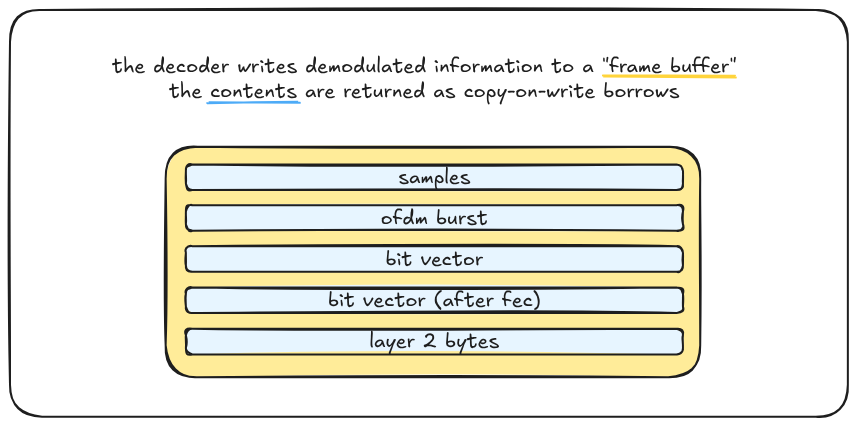
This pre-allocated block of memory to hold the burst’s data is something that
I’ve called a frame buffer internally. Each frame buffer contains exactly
sized buffers to hold decoded information from the burst – an iq buffer
that is exactly the same number of samples required to encode the preamble
and data, exactly the number of bits needed to store pre and post FEC data,
pre-allocated byte array, etc.
Not shockingly, the code looks like this:
#[derive(Clone)]
pub struct FrameBuffer {
    /// Corrected IQ samples
    pub samples: Samples,

    /// post-correction OFDM burst
    pub burst: Burst,

    /// demodulated bits from the OFDM burst
    pub bits: Vector,

    /// demodulated bits from the OFDM burst,
    /// after FEC, and cleaned
    pub raw_bits: Vector,

    /// Layer 2 contents of the Frame
    pub contents: Vec<u8>,
}
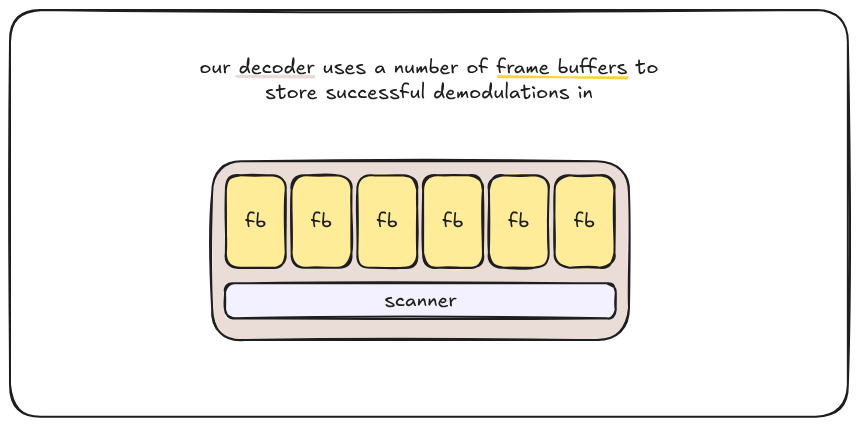
Of course, that alone is handy – but we need to use them. So let’s go ahead
and do what we promised above – each Decoder uses a fixed number of
pre-allocated FrameBuffers to store packets in-flight, packed into what
is, creatively, called FrameBuffers within my code.
As an aside, I likely should have called this a
Memory Pool, since that’s the
common
and accepted
name for this design pattern – but being stuck with unfortunate names is
the burden of those of us who stumble into sensible ideas over time. The only
nuance here is that I use the pools strictly sequentially – we only “save”
the FrameBuffer if the LDPC checksum is correct, allowing us to only keep
track of how many successful packets we have and being able to get the valid
FrameBuffers, rather than storing a handle to each FrameBuffer as we go –
a promise that most memory pools do not make, since blocks can usually be
taken and returned in any order.
Let’s go ahead and do the whole Decoder dance now:
// (lightly edited for clarity)

impl Decoder {
  ..

  /// Process incoming IQ for Pigeon Bursts, and
  /// demodulate them.
  pub fn decode(
    &mut self,
    buf: &[IQ],
  ) -> Result<Vec<(Detection, &FrameBuffer)>, Error> {
   let mut ret = Vec::new();
   let mode = self.scanner.mode().clone();

   // reset the "valid frame buffer count" back to 0
   self.frames.reset();

   // call the scanner and get scan detections for
   // this block of iq (`buf`)
   for detection in self.scanner.scan(buf) {
     // for each detection, we're (only) going to process
     // the iq snippit, but pass along the metadata
     // such as SNR.
     let ScanDetection {
       snippit,
       snr,
       range,
       m,
     } = detection;

     // grab the next free frame buffer to work within.
     let frame_buffer = self.frames.next_mut();

     // Copy the snippit into the frame buffer (a mutable
     // location)
     frame_buffer.samples.copy_from_slice(snippit);

     // estimate the frequency offset based on the
     // Burst's Schmidl-Cox preamble.
     let preamble_fo = preamble::estimate_frequency_offset(
       &mode.preamble,
       mode.rate,
       &frame_buffer.samples[..mode.preamble.samples()],
     );

     // Shift the IQ stream by the estimated frequency
     // offset -- hopefully we're closer to 0Hz
     frame_buffer.samples.shift(mode.rate, preamble_fo);

     // estimate the frequency offset based on the
     // each burst's **cyclic prefix** -- exactly like
     // we did with the Burst Schmidl-Cox preamble,
     // but this time on each OFDM symbol.
     let ofdm_fo = ofdm::estimate_frequency_offset(
       &mode.ofdm,
       mode.rate,
       &frame_buffer.samples[mode.preamble.samples()..],
     );

     // Shift the IQ stream closer yet; hopefully this
     // is a very small nudge even closer still to 0Hz.
     frame_buffer.samples.shift(mode.rate, ofdm_fo);

     // Do a bunch of inverse fft operations for each
     // OFDM symbol, filling the frequency-domain Symbol
     // structs in `frame_buffer.burst` (Burst) struct.
     //
     // this will also do channel estimation and
     // correction before returning.
     self
       .decoder
       .transform(
         &mut frame_buffer.burst,
         &frame_buffer.samples[mode.preamble.samples()..],
       )?;

     // "demultiplex" each data subcarrier's frequency-domain
     // IQ constellation point, setting the correct bit range.
     self.decoder.demultiplex(
       &mut frame_buffer.raw_bits,
       &frame_buffer.burst
     );

     // unapply whitening by XOR-ing the buffer with
     // the well-known whitening vector.
     frame_buffer.raw_bits = frame_buffer.raw_bits.xor(
       &self.whitening);

     // verify that the LDPC message(s) are all correct,
     // and if so, concatanate the the data bits (no check
     // bits) to the `bits` vector.
     if self.fec.decode(
       &mut frame_buffer.bits,
       &frame_buffer.raw_bits
     ).is_err() {
       // this is where invalid packets fail. we gave it a good go.
       // next packet please.
       continue;
     }

     // copy the raw bits out, as bytes, to the `contents` buffer.
     frame_buffer.bits.copy_as_bytes(&mut frame_buffer.contents);

     // store metadata/metrics on the demodulation.
     ret.push(Detection {
       m,
       snr,
       index: range.start,
     });

     // save the contents of this frame buffer (don't
     // reuse this buffer next go-around).
     self.frames.save();
   }

   // We're going to take out the borrow on the frame at
   // the end since we don't want to deal with telling the
   // compiler via code gymnastics that the mut and non-mut
   // borrows are OK since they're non-overlapping.
   Ok(ret.into_iter().zip(self.frames.iter()).collect())
  }
}
Phew. That was kinda a lot. In fact it’s basically the whole thing. This function is as close to “how do you read an OFDM packet” as it gets, and perhaps the most important part of this whole series. Beyond that, though, this is a huge conceptual unlock. This means we now have an incredibly powerful primitive; the ability to take bytes and go to/from IQ samples over the air.